
Local Stories
Stories of Local People and Events
This folder will feature various the stories about people, places and events which helped shape our community.
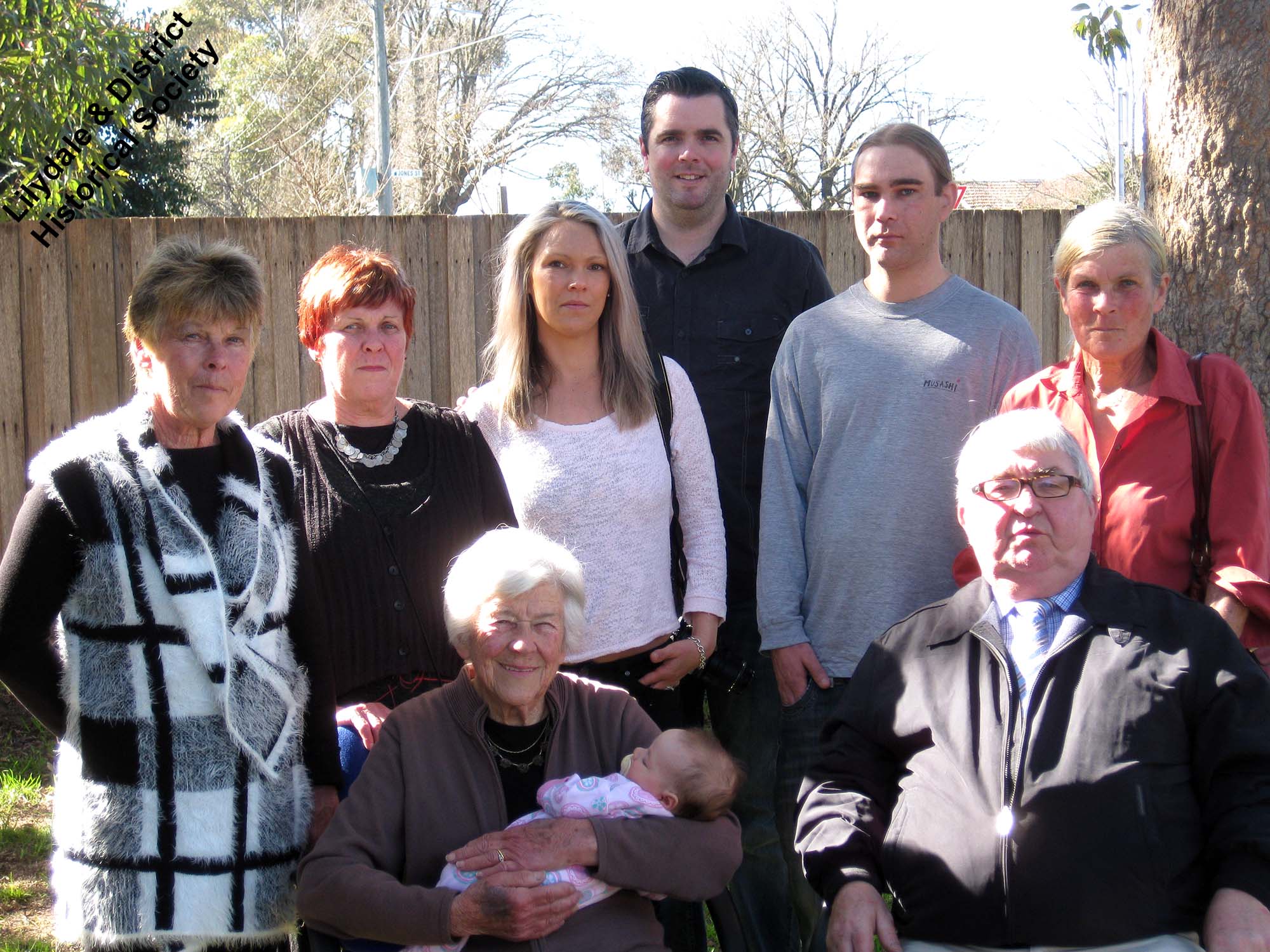
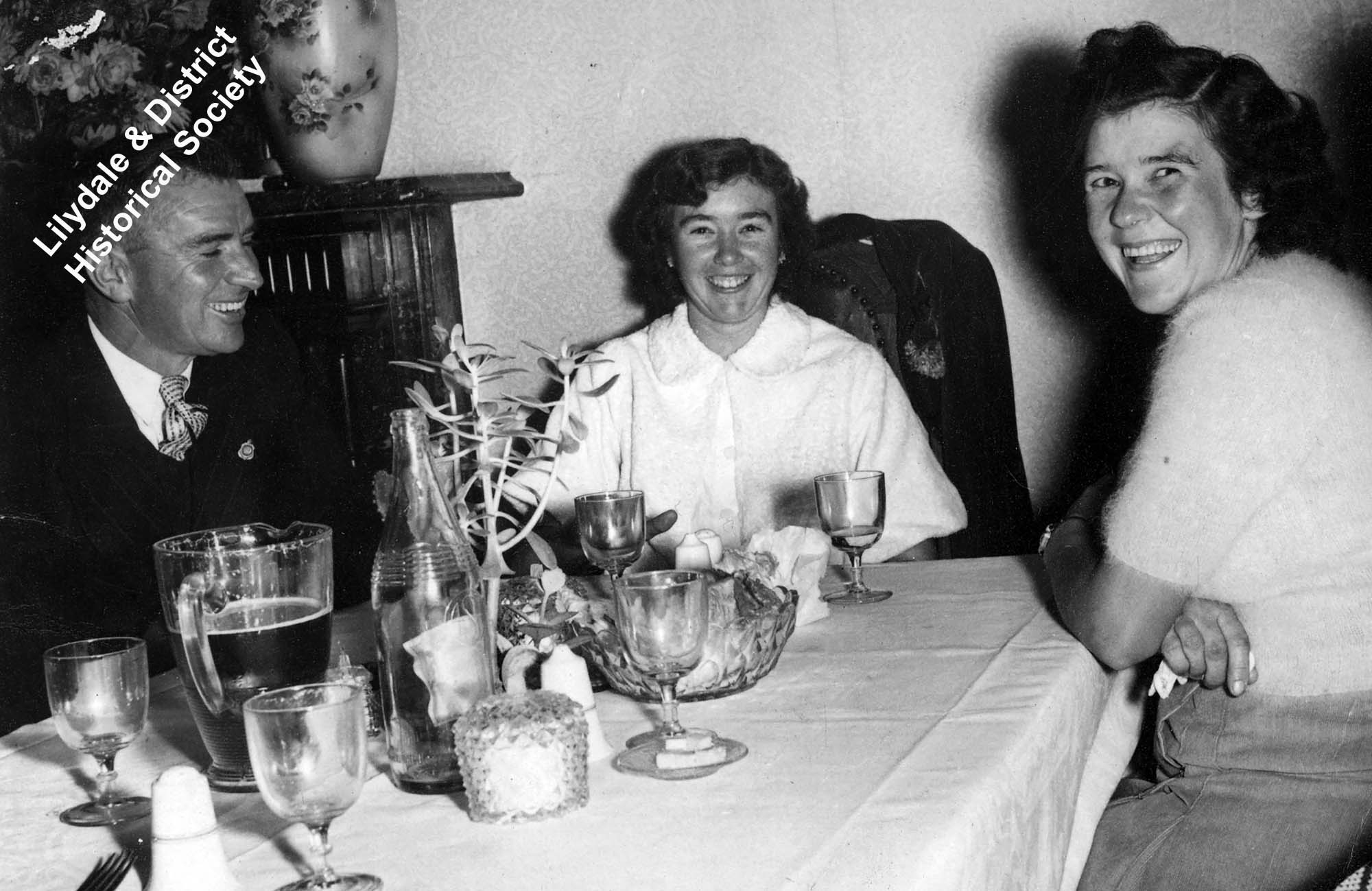
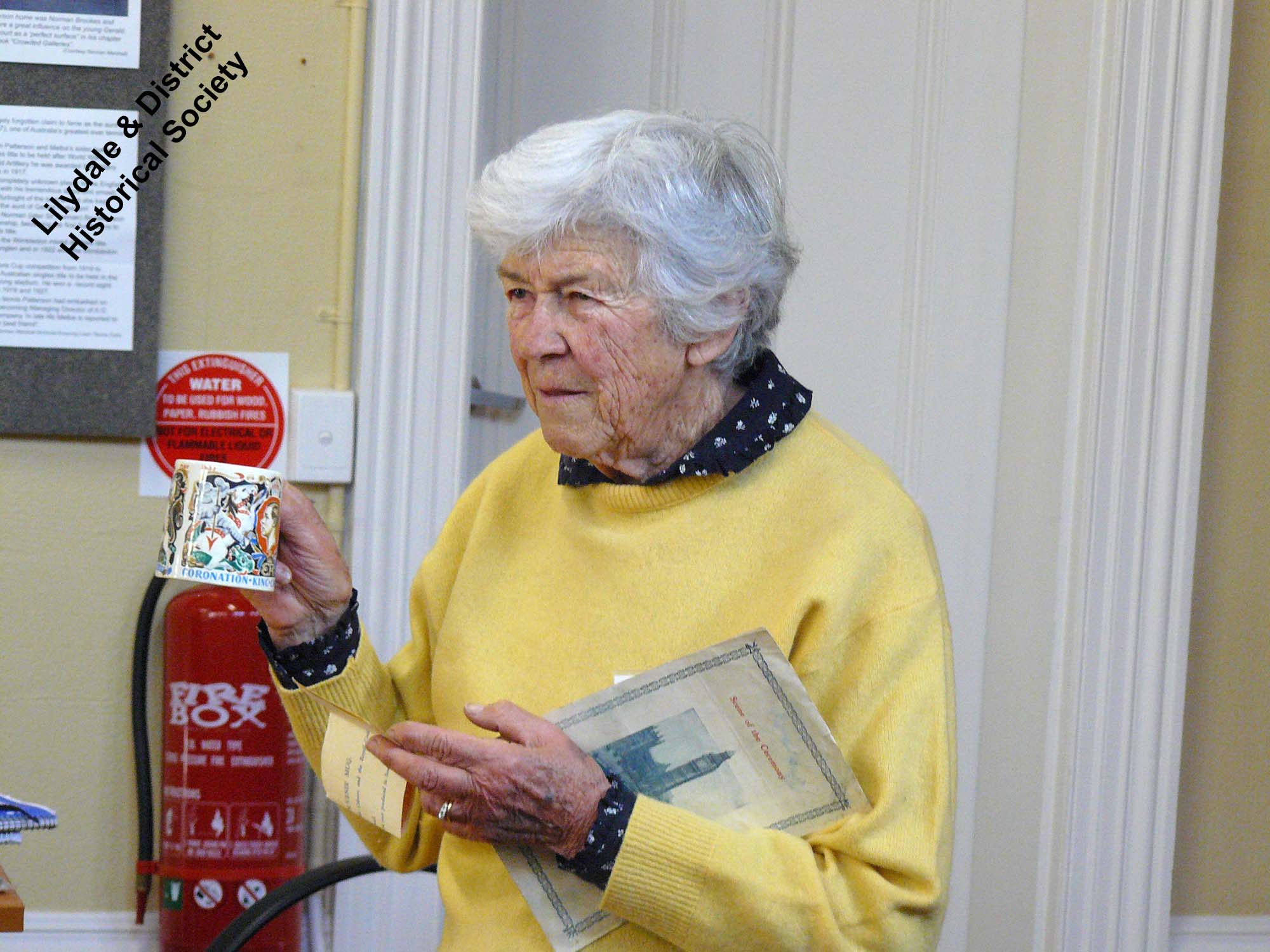
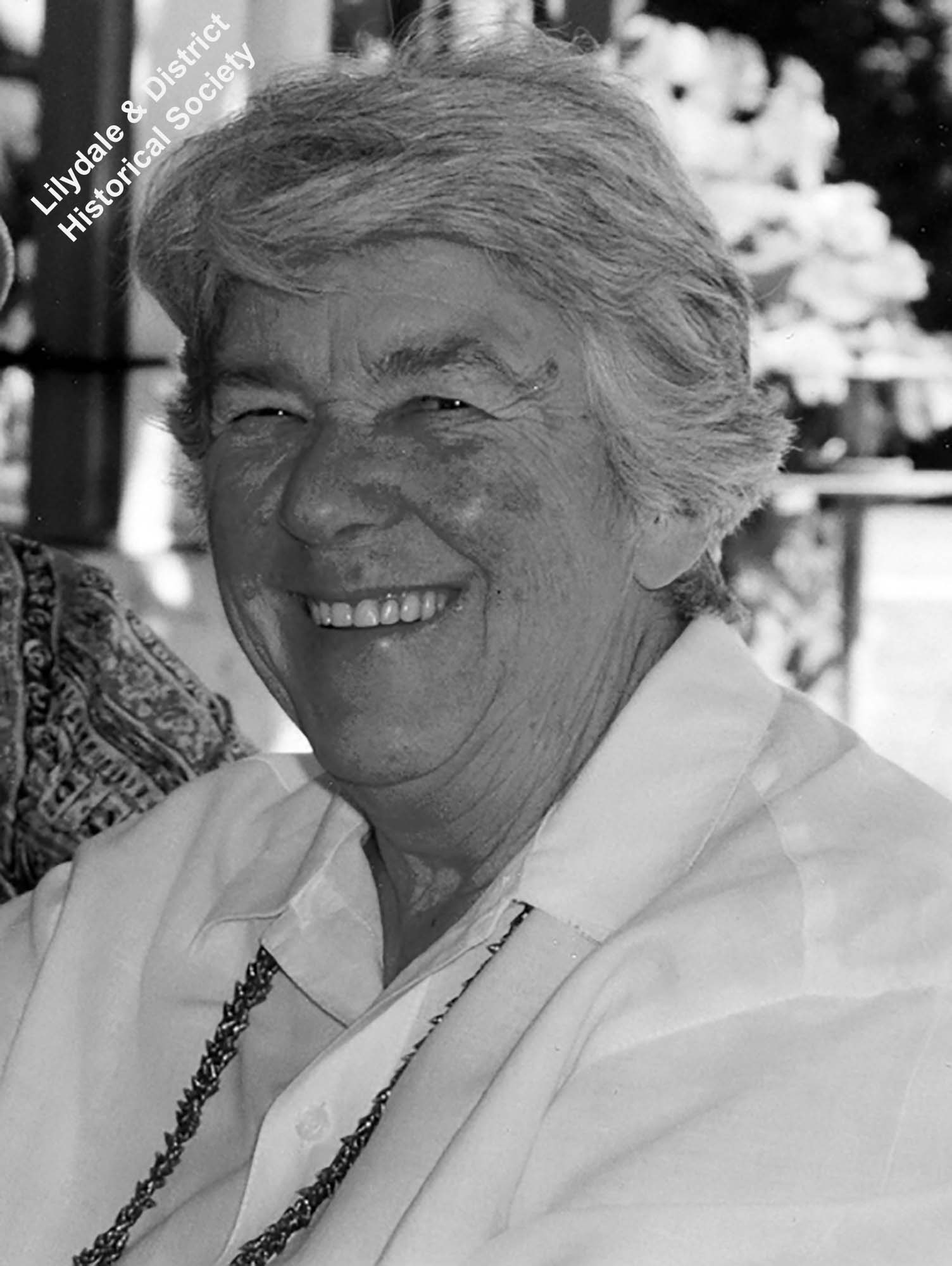
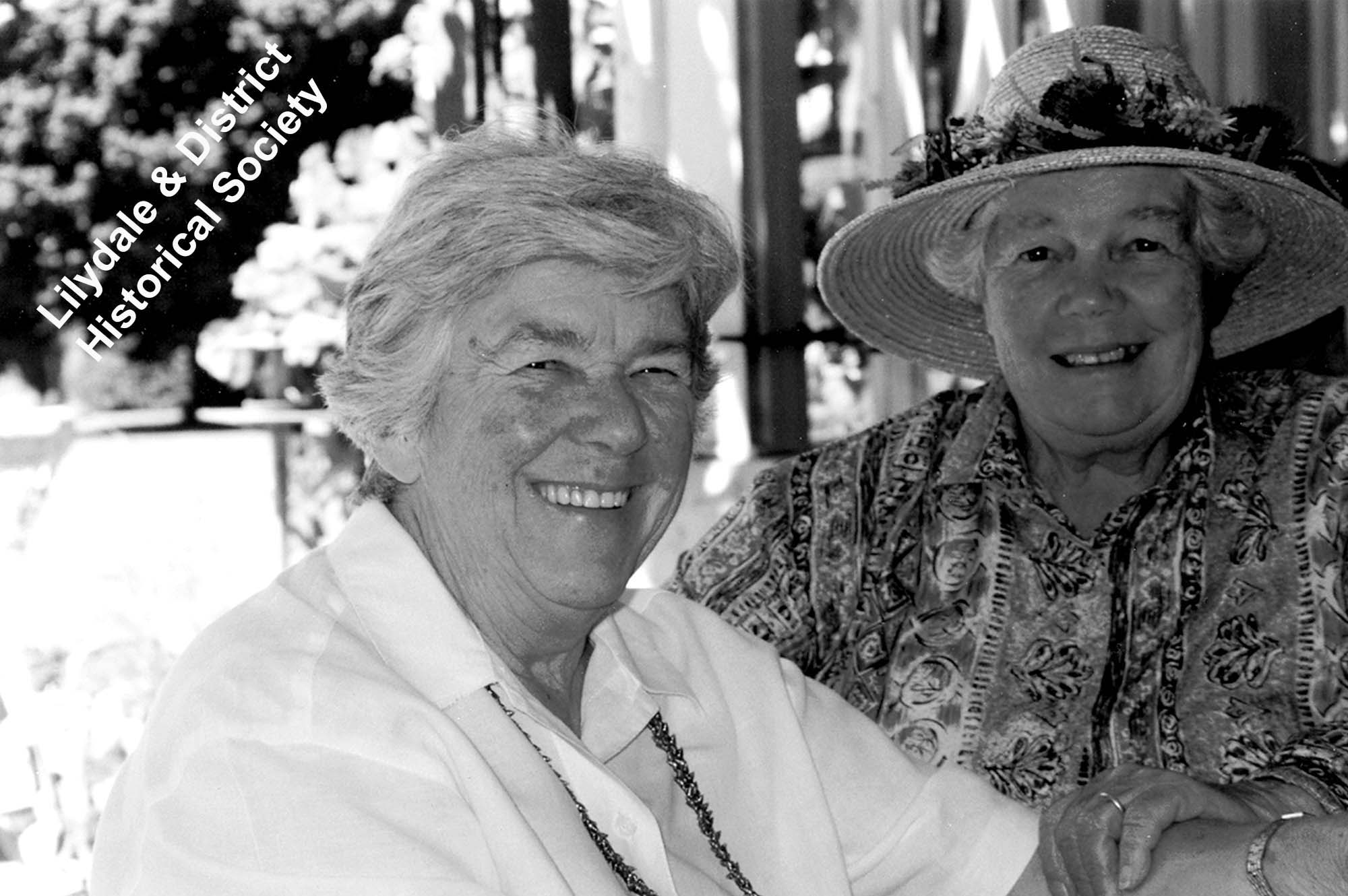
Val Sheehan (1927 – 2015)
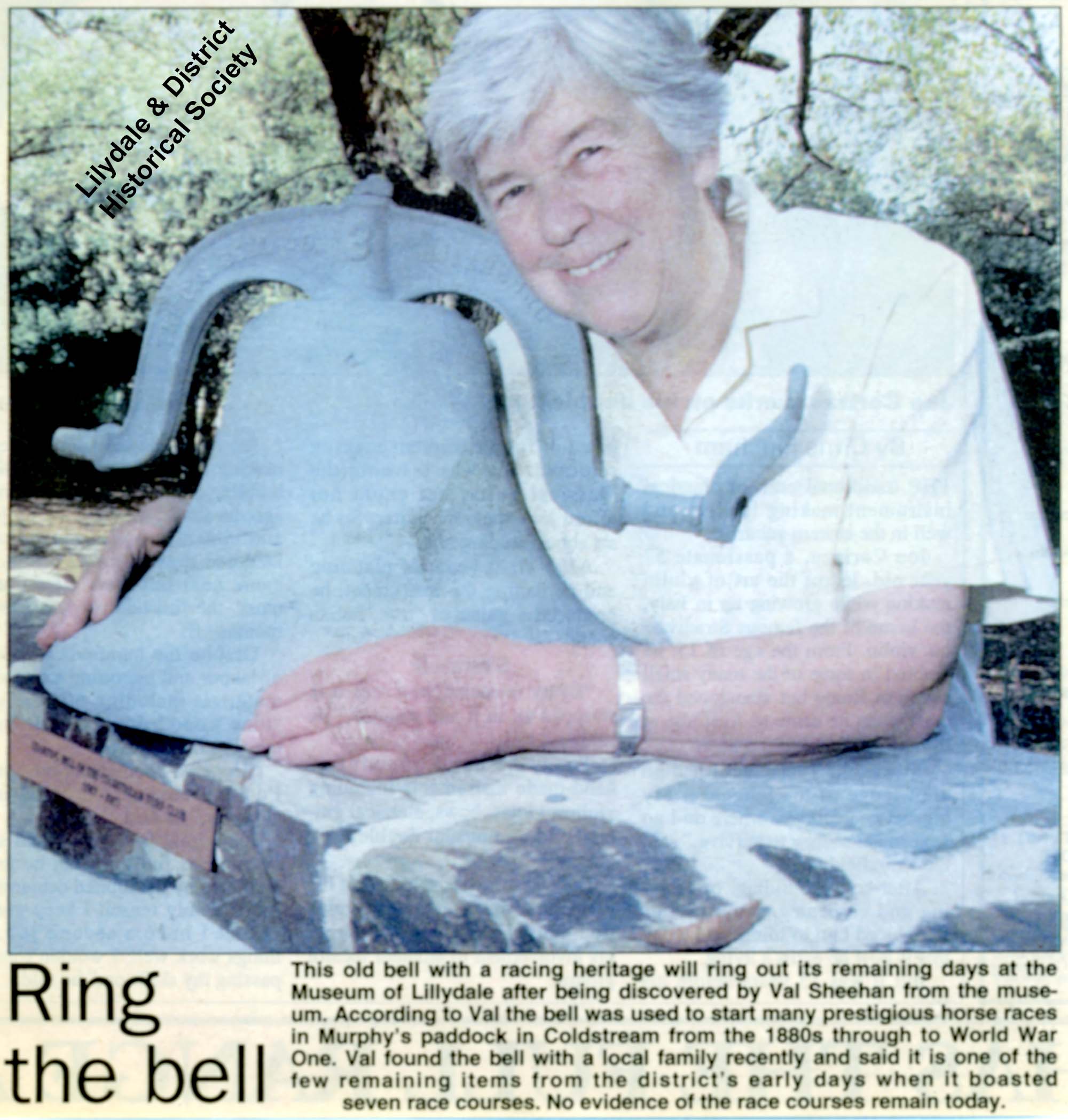
Val Sheehan lived in Coldstream from 1947 until her death in 2015.
Valma Jean Sheehan (nee Skate) was born on April 2, 1927 at Koondrook near Barham on the Murray River and died 27/3/2015).
In 1943 at the age of 16 Val moved to Coldstream with her parents and siblings where she lived for the rest of her life.
Val was affection ally known as ‘Mrs Coldstream’ by members of Historical Society and during her lifetime was passionate about recording the history of the Yarra Valley.
In 1946 her first job was at the local Coldstream Store and Post Office where she started to build her lifelong connections with the local families of the district and her love of the district. She and her family were staunch supporters of both the Coldstream Cricket Club formed in 1949 and the Coldstream Football Club formed in 1952. In the 1970s she complied a record of newspaper articles and photos of the football club from 1952 to 1972 for its 25th anniversary.
Val was interested in history and local people and as her children attended Yering Primary School, through her inspiration, she became involved in the researching of the “Memories of Yering the History of Yering Primary School” for the school’s 120th anniversary (1989). When more material emerged, Val, who joined the Lilydale & District Historical Society in 1990 started on a second book to celebrate the school’s 125th birthday called Further Memories of Yering” (1994).
This was the first collaboration between Val and historian and publisher Sue Thompson of the Lilydale & District Historical Society. Her family history book was ‘They came to Rushworth” a genealogy of the Skate/Clayton/Muller families of the district. This was followed by another book about her family – The Smith Family published in 1996.
As a member of the LDHS, Val was an active member as both a volunteer and committee member. Right up until her short illness, she attended our monthly committee and general meetings as well as being a part of the monthly roster which enables the society to be open to the public. She was researching and developing information for our display boards up until she died.
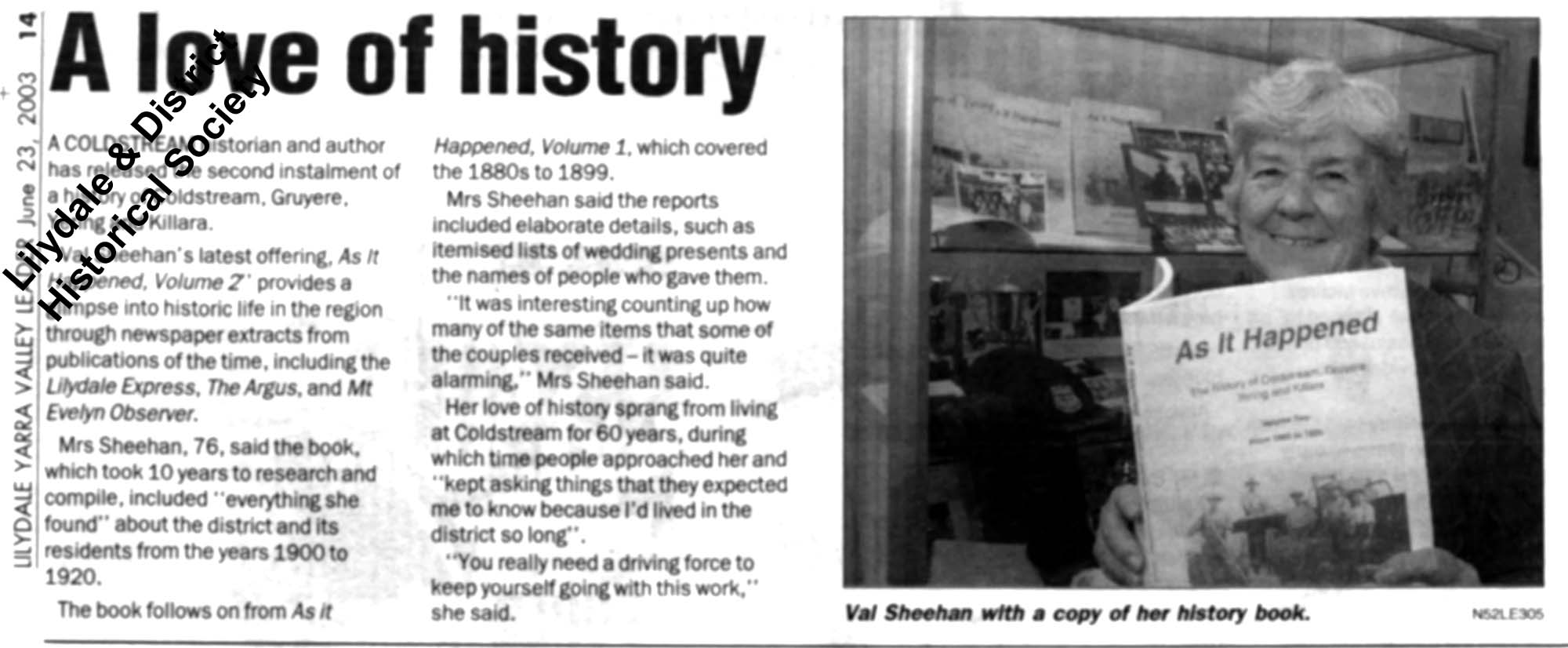
Val decided to write a history of Coldstream through the pages of the local newspaper the Lilydale Express. The result was many months of reading every page of the newspaper for 1886 through to the 1960s. Month after month she would spend days in the local library using the microfilm reader and printing out page after page of Coldstream articles. While doing this Val also compiled every birth, death and marriage from each paper and this has now become a valuable society database resource.
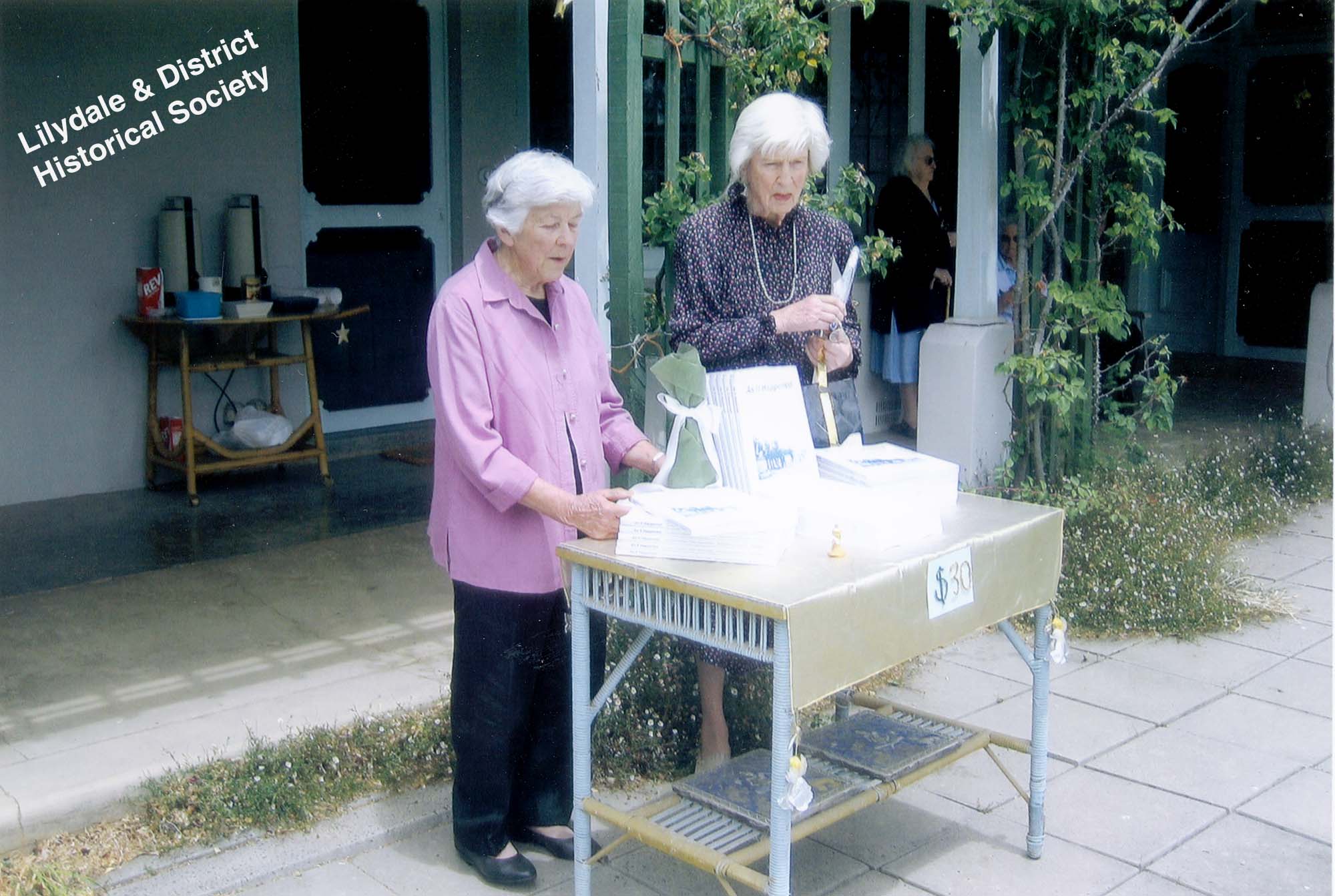
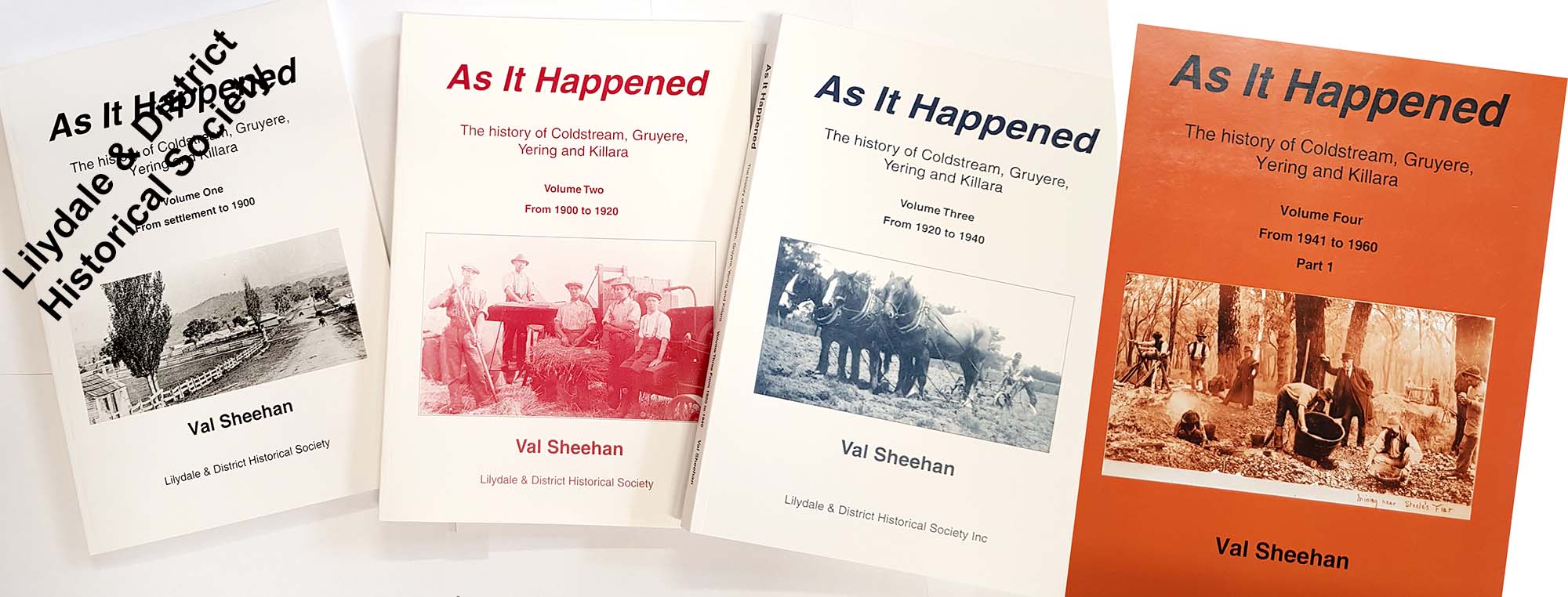
Val carefully trimmed and dated each Coldstream article before giving them to Sue Thompson to scan and add to each of the four volumes of ‘As It Happened The history of Coldstream, Gruyere, Yering and Killara.’
Volume 1 – Settlement to 1900 (published 2001)
Volume 2 – 1900 to 1920 (2003)
Volume 3 – 1920 to 1940 (2006)
The final volume 1940 to 1960 (published posthumously in 2017).
While researching these books Val was also busy taking to Coldstream families and gathering copies of family photos for both the books and to add digitally to our LDHS photographic collection.
Val also collaborated with other members of the Lilydale & District Historical Society in the production of publications:
Unmarked Graves at the Lilydale Cemetery Volume 1
Reminiscences of Life – Memories of Lilydale residents, which she featured in.
Gun Alley – the story of the Backstreets of Lilydale.
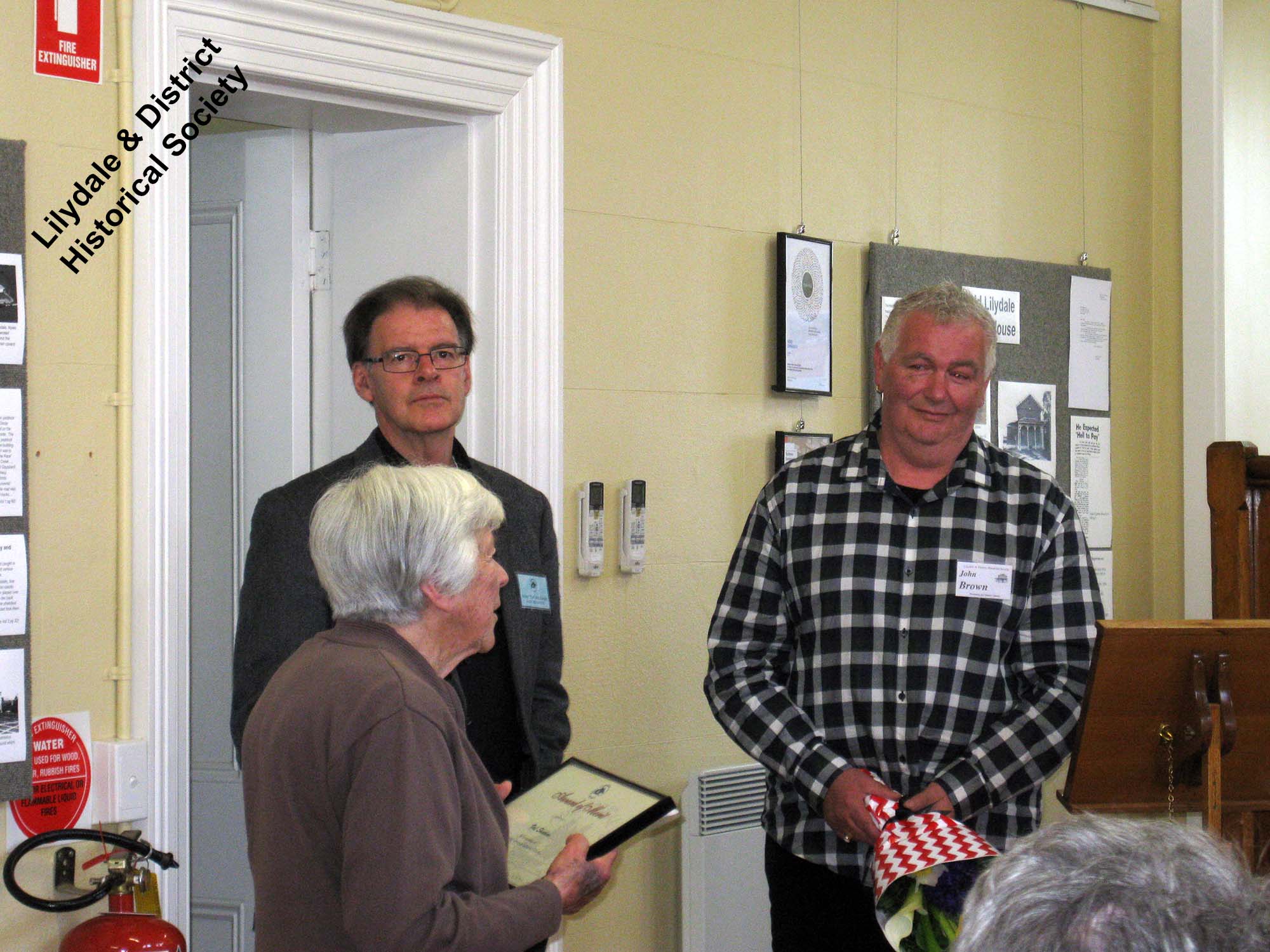
In recognition of her contribution to local history, in 2005 Val was awarded a ‘Certificate of Recognition by the Shire of Yarra Ranges’ for her contribution to the Coldstream area. Val became a life member in 2008 for her outstanding contribution to researching and recording of local history of the old Shire of Lillydale. In 2014 the President of the Royal Historical Society of Victoria Associate Professor Don Garden awarded Val with the RHSV’s Award of Merit in recognition of her service to local heritage.
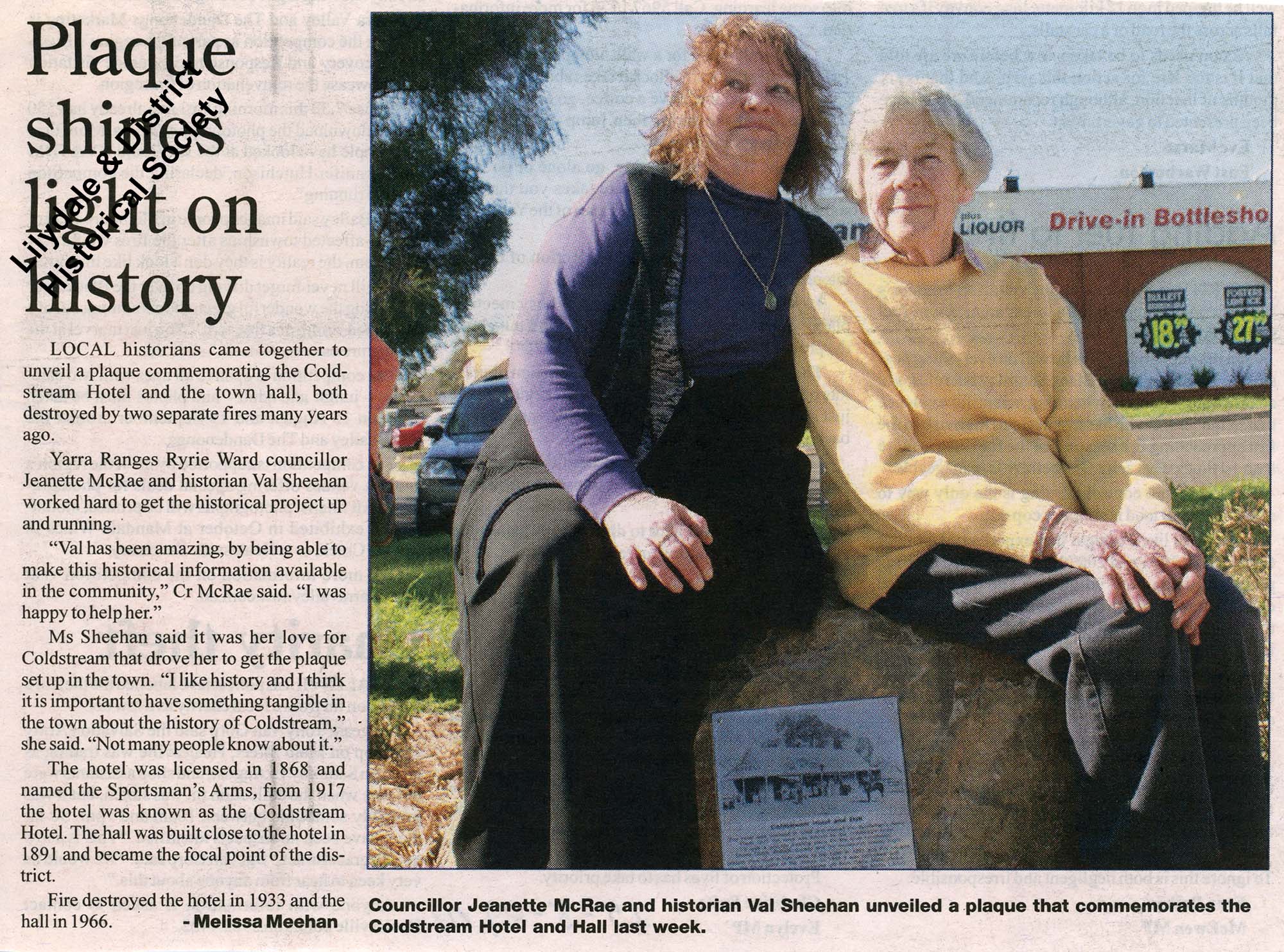
Val was also involved in most projects in and around Coldstream. She was instrumental with her brother Les Skate in erecting the Coldstream and Yering War Memorial in 1995. She assisted her daughter Christine, in raising many thousands of dollars for local charities at the annual Wallace Garden in Maddens Lane, Coldstream, over the Melbourne Cup weekend.
For 39 years she worked at Coombe Cottage and became a close friend and companion to Pamela Lady Vestey and together they shared a passion for preserving the memory of Dame Nellie Melba, Lady Vestey’s grandmother.
Val died on March 27, 2015 after a short illness. She was 88 years old.
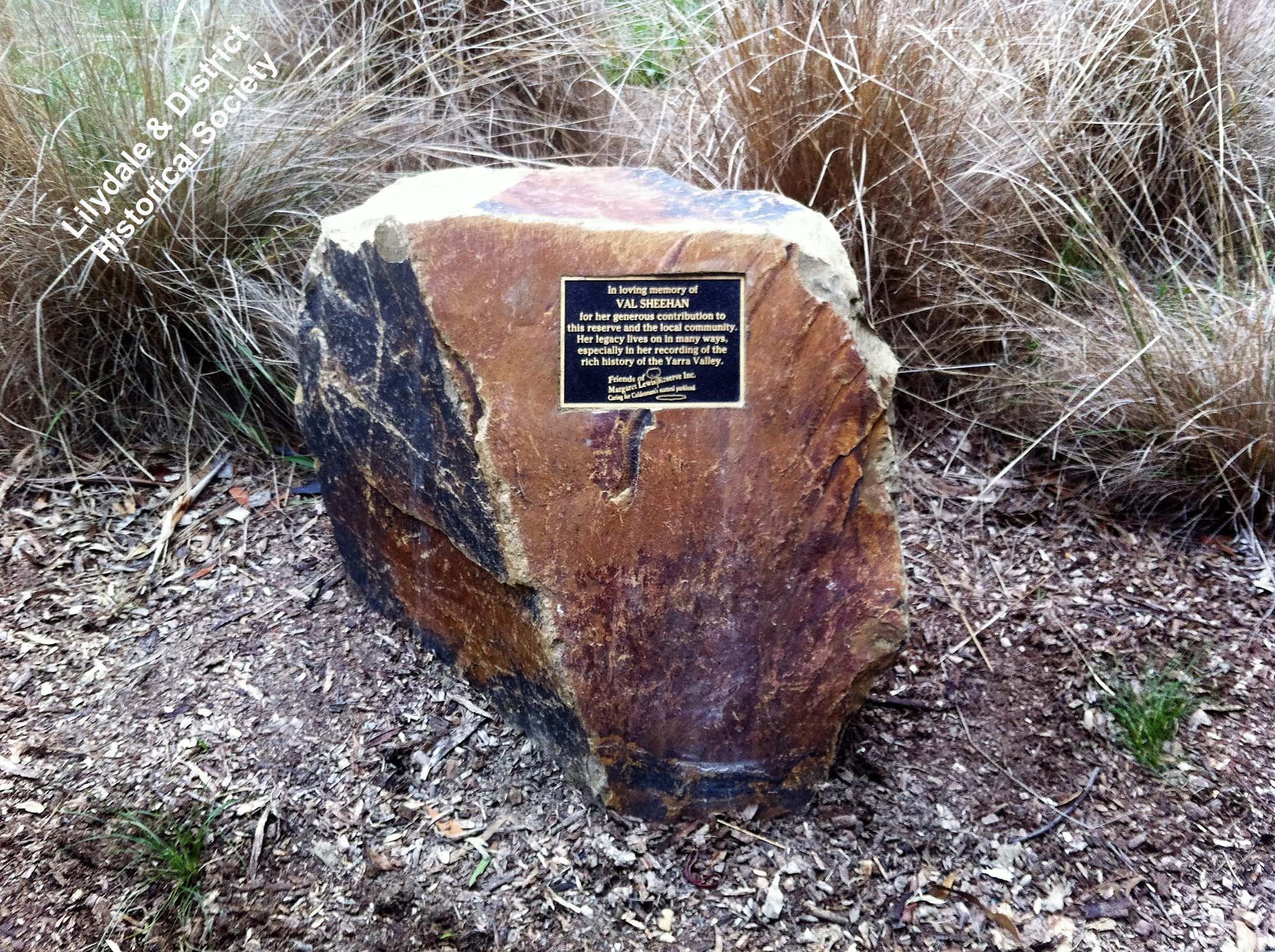
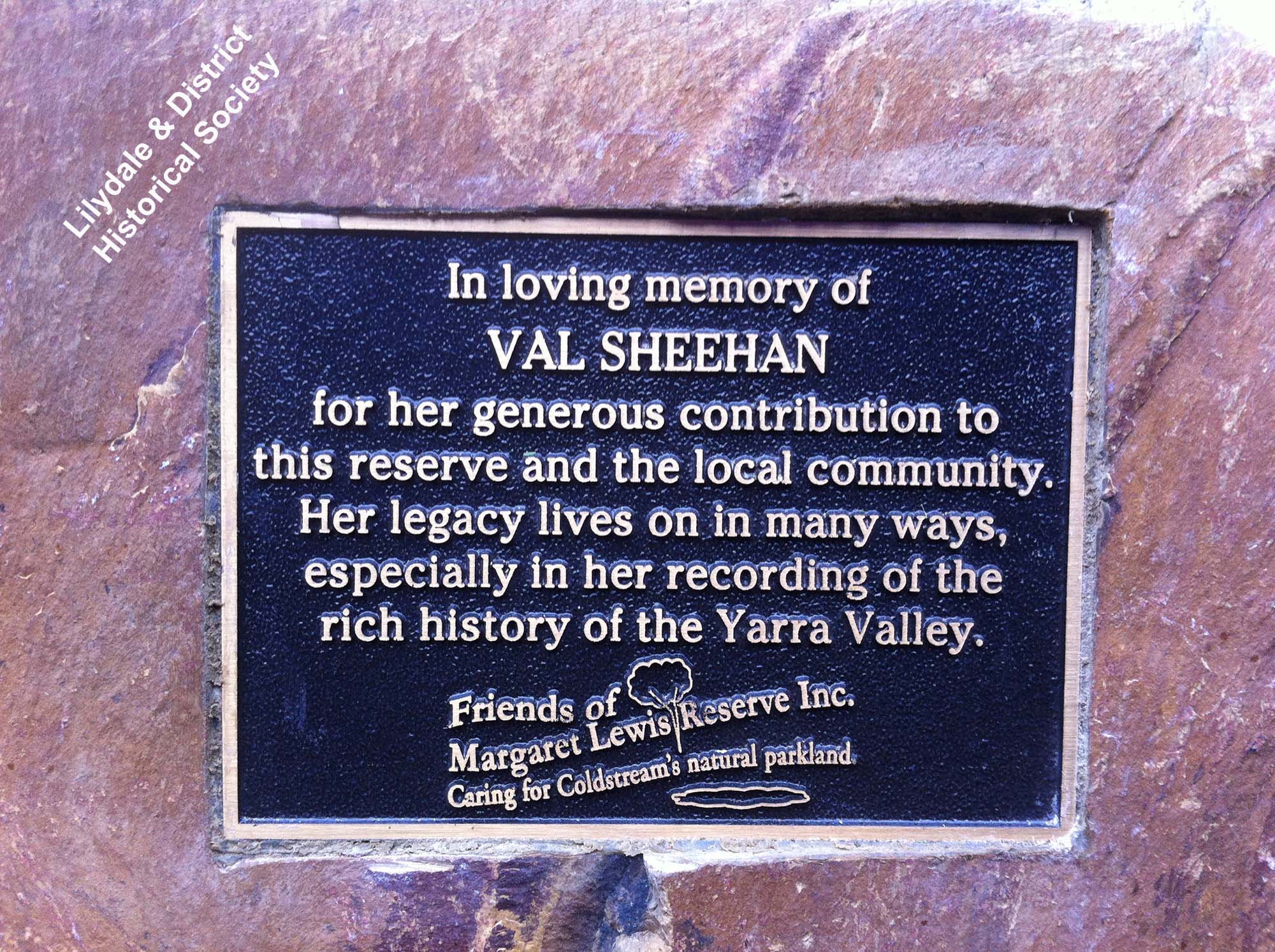
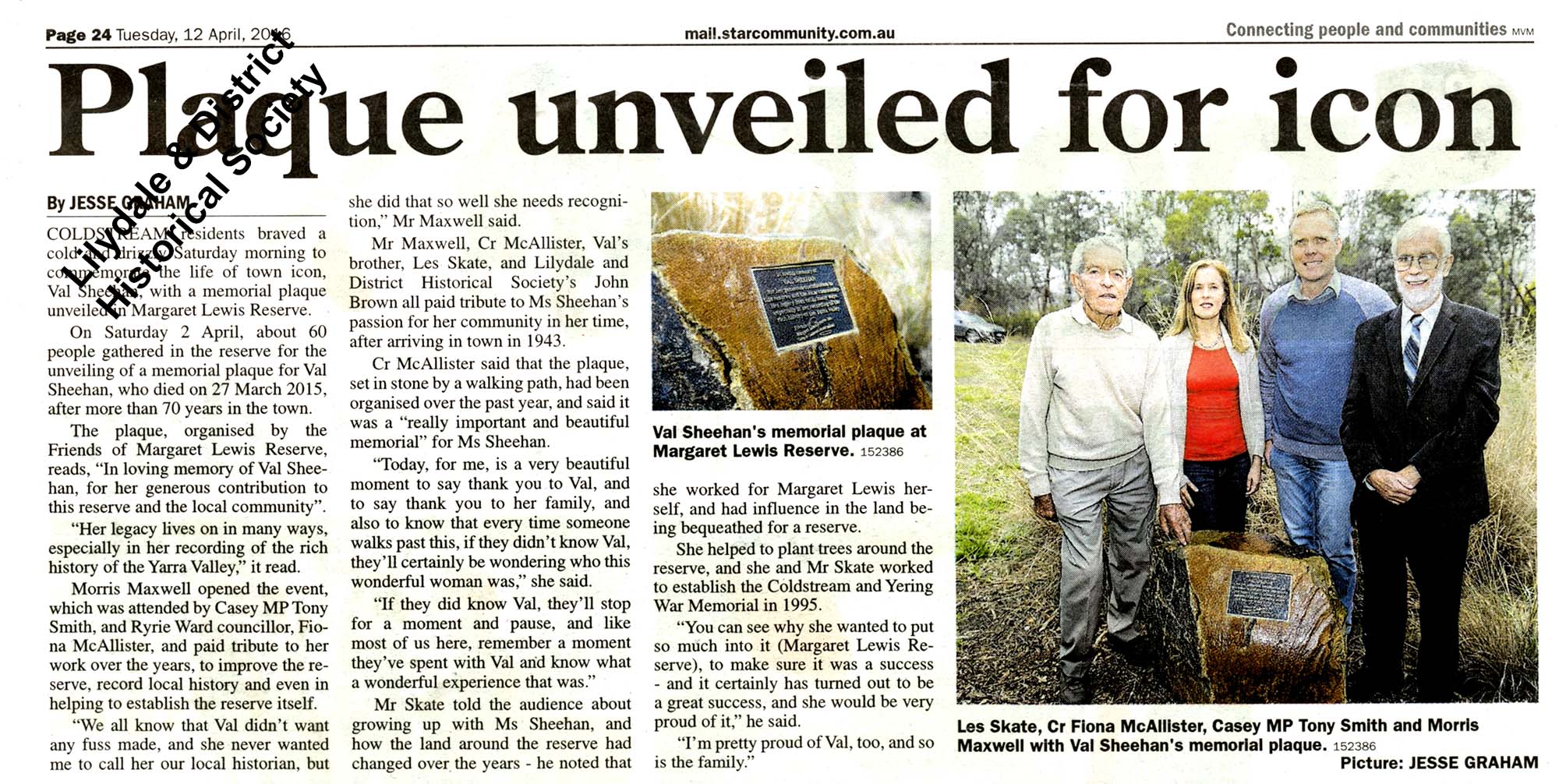
After her death a memorial stone was laid at the ‘Margaret Lewis Reserve’ in Coldstream on April 2, 2016 which reads:
‘Her generous contributions to this reserve and the local community. Her legacy lives on in many ways, especially in her recording of the rich history of the Yarra Valley’.
Val was a stalwart of the society, a quiet lady, always there with a welcoming smile, always willing to help and interested in what everyone was doing. She is sadly missed, but her contribution continues to be her lasting legacy.
Cecil Lester’s WWII service
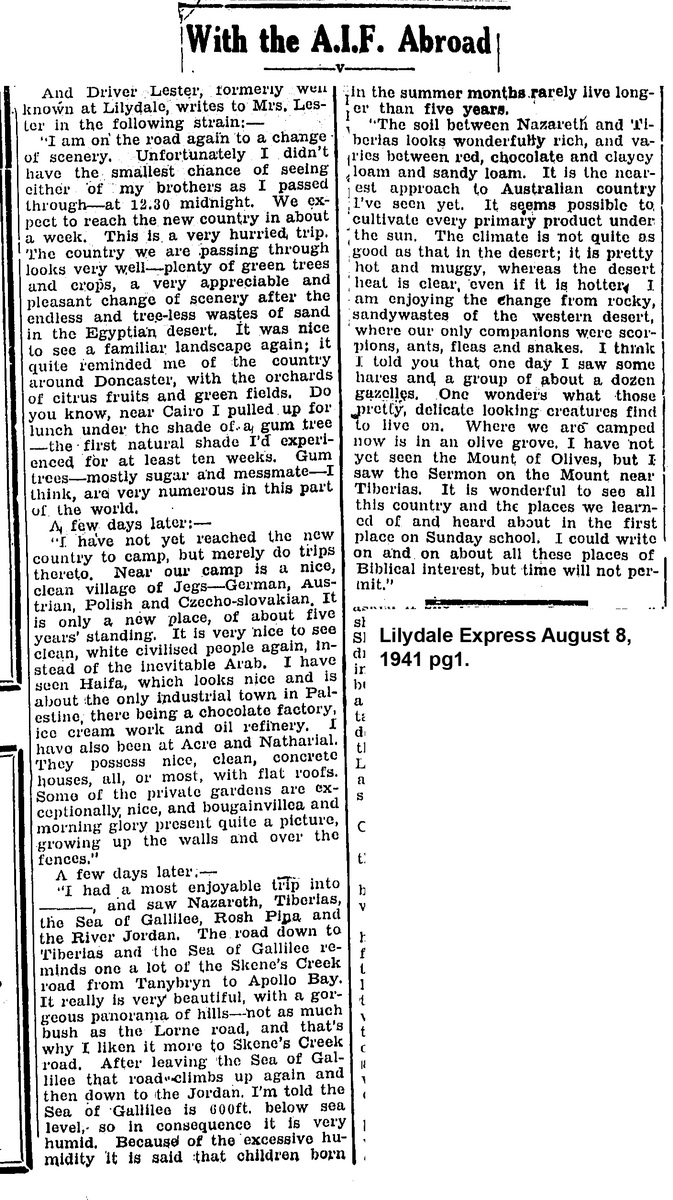
Cecil Standish Lester left Melbourne on December 29, 1940 for the Middle East. Becoming part of the 105 Transport Coy, on March 1, 1942 he left the Middle for Batavia arriving on February 12, 1942. He was reported missing at Java on March 7, 1942 and confirmed as a prisoner of War on July 13, 1942. Interred at a Thai camp in December 22, 1943 he worked on the Burma Railway. He was reported alive and finally recovered from the Japanese in Siam on August 10, 1945. Cecil left for Australia on September 29, 1945 arriving in Melbourne on the Taramoa on October 7, 1945.
After receiving medical treatment, he was discharged from the Army on February 2, 1946.
Summary from Cecil Lester’s World War II service record (VX19178)
1st Australian Corps Petrol Park and later in the Middle East 105 General Transport Coy.
May 29, 1940 Cecil signed up
June 12, 1940 Went into camp.
December 29, 1940 Embarked at Melbourne for the Middle East on the Maurintania
January 30, 1941 Disembarked in the Middle East.
February 1, 1942 Embarked for Batavia.
February 18, 1942 Disembarked at Batavia. (Note: Singapore fell on February 8, 1942)
March 7, 1942 Missing – believed to be a prisoner of war.
April 4, 1942 Reported Missing in Action date unknown.
August 23, 1943 Reported as a Prisoner of War.
December 12, 1943 Now interred in Thai camp.
December 22, 1943 Transferred to Thai camp.
August 20, 1945 Alive in Siam recovered from the Japanese.
September 29, 1945 Embarked on the Tamaroa for Melbourne.
October 17, 1945 Disembarked in Melbourne.
February 11, 1946 Discharged.
Decorations
1939/45 African Star
Pacific Star
Burmese Star
Defence Medal
War Medal
Dorothy Una: Helping families and soldiers
Dorothy Una was the youngest member of the Moroney family, the only child born in Colac and the only female family member not to marry.
Dorothy who was born on August 2, 1884 would have started school at Lilydale State School in about 1890 or 1891.1
In 1894 Dorothy was in the third class and at the end of the year, was awarded first prize in writing.2
Like her sisters, Dorothy seemed to enjoy the limelight as in December 1895 she performed a recitation ‘Grandpa’s Spectacle’ for the school end of year concert and presentation. She was also conscientious as she received a prize for being third in class work among the girls of the fifth class.3
At the 1896 speech day, Dorothy received first prize among the girls of the fifth grade for general work.4
Just four years, later, as the Lilydale Express reported, Dorothy and her young friend spread the word about the relief of Mafeking by ringing the church and school bells:5
On Saturday morning May 19th (1900) two young ladies, Misses Walton and Moroney, were going about their business in Lilydale when they heard the news that Mafeking had been relieved only two days before. They each ran to the bells at St John’s Church and the Lilydale State School and began ringing them as a resounding message of the good news. Within hours the townspeople had joined them banging dinner bells and other clarion like instruments joyfully while union Jack flags quickly went up in the front window and balconies of the shops in Main Street.
Later, the Express wrote:
The people of Lilydale were not behind hand in showing how enthusiastic they can be when the occasion arises. By late afternoon over 100 men from Cavehill were marching up and down Main Street behind the Lilydale Brass Band singing patriotic songs.6
One wonders if the seige at Mafeking prompted Dorothy’s brother Jack to sail to South Africa where, in July 1901, he enlisted in the South African Light Horse.7
After completing her schooling, Dorothy became a nurse but I do not know where she did her training.
With the outbreak of World War I, Dorothy was soon on her way to enlist. As her brother had returned from the Boer War with permanent injuries, he was not medically fit and she would have felt it her duty to serve her country.
Dorothy enlisted as a sister with the Australian Army Nursing Service and her unit was given as the British Indian Service A.I.F.8
She signed the enlistment papers on August 16, 1916 but the date of her joining was given as six days later at Melbourne on August 22, 1916, the day she embarked on the Royal Mail ship Moolton.
On her papers, Dorothy, 30, gave her occupation as a nurse. She was not a tall woman – 5ft 3^ inches and weighed 9 stone 10lb. Her complexion was fair, she had brown eyes and fair hair.9.
The Moolton sailed to the Middle East where Dorothy disembarked at Suez and saw service at Mesopotamia and India.
After her service in the Middle East, Dorothy was posted to Bombay in India. On July 11, 1917 at Bombay she boarded the Royal Mail ship Malwa and sailed to Alexandria where she disembarked on August 4, 1917.
Remembering her sister, Eileen wrote many years later in her obituary to her sister:
Dorothy nursed in snows and discomforts of Salonika and later was head theatre sister of the immense hospital in the intense heat of Poona, India, and in Egypt.10
In a letter to her brother, Dorothy describes the scene which greeted the nurses.
Oh the different atmosphere on board here to the boat in which we left Australia twelve months ago. Then the other passengers seemed to resent military nurses even travelling in the first saloon, whereas here no one can do enough for our entertainment and our little party really has the jolliest time. We were the only passengers to leave the boat. Those remaining on board lined the rails and gave us a great send off which rather effected some of us. We landed at Port Tuefig and invaded the only hotel for afternoon tea; we eventually boarded the train for Alexandria. At several stations we saw Australian hats so we hung out and “coo-eed” which of course brought them along and it was lovely to see them. Everybody has said how dirty Cairo was but compared to Bombay it is most beautifully clean. Here the natives have picked up a lot of Australian slang, and one who posed as a guide said when I told him I did not require a guide, “I’m not an ordinary guide sister; I’m the dinkum Moses”. Palestine may be our destination and as all the British troops have been transferred from a place we were expecting to go to, none of us is complaining.11
At the end of the war, Dorothy returned to Melbourne on December 22, 1918 and was discharged on March 1, 1919. She was awarded the British War Medal and Victory Medal 1914-1919.12
After her war service, Dorothy continued to help returned soldiers and went to the Caulfield Military Hospital and kept in touch with many of the servicemen she nursed over the years.13
Like her brother Jack, Dorothy had close links with the Lilydale branch of the RSSILA (Returned Sailors, Soldiers Imperial League of Australia). The newly formed club resolved to accept Sister Moroney as a member and that all nursing sisters from the area would be honorary members and be granted life membership of the branch.14
Dorothy remained at Lilydale living firstly at the family Belle Vue home and after her mother’s death moved with Hilda and Jack into their Anderson St, home.
Later she served the Collingwood community as the nursing sister at the Collingwood Baby Health Centre. 15
During the early 1930s, Dorothy witnessed first-hand the poverty and desperation the Depression was having on the families of Collingwood.
In true Moroney style, she launched a campaign in Lilydale to help the less fortunate.
Through the Lilydale Express she thanked people for their help.
Dorothy told the Lilydale Express:
“Everything has been personally distributed, and has been the means of helping and caring for many destitute families. Over 50 pots of jam and dripping were collected in Yarra Glen and district by Mrs Allan and Mrs Bell, a wonderful result considering the many calls on people’s liberality at present.” 16
In 1934, Dorothy became dangerously ill after an operation and was in the Alfred Hospital, Prahran, but she recovered and continued working. 17
World War II must have been a difficult time for Dorothy as she would have known first hand the trials and tribulations the servicemen and women would be suffering. Her own nephew Jock Finlay had enlisted.
Dorothy’s death in 1949 aged 65 years came as a shock to the community. The Lilydale Express reported:
Obituary
Death of Miss Dorothy Una Moroney
Although in indifferent health for some time past, the announcement of the death of Miss Dorothy Moroney, which occurred whilst on a visit to the city on Friday, was a most distressing shock to district residents, particularly those who have enjoyed her acquaintance since girlhood. Whilst partaking lunch with her two sisters (Mrs Eileen Finlay and Mrs A. E. Syme) at the former’s home at Armadale, Miss Moroney suddenly collapsed and death ensued immediately.
For over 50 years the Moroney family have been prominently identified with the social, charitable and patriotic affairs of the community in which the deceased was ever in the forefront, her affable personality and readiness at all times to render service in any worthy cause endeared her to all she came in contact with. In the first world war conflict, she enlisted as a nurse and served in many theatres of war.
Since the death of her mother, the late Miss Moroney resided with her sister, Mrs A.E. Syme, in Anderson street, Lilydale. To the latter and her other sister, Mrs Finlay (better known in literary circles as Eileen Finlay) the deepest sympathy is extended. The funeral took place at the Springvale Crematorium on Wednesday, where an impressive service was conducted by the Rev. W. Milne. Mr Ralph Goode, on behalf of the local sub-branch of the R.S.L. of which the deceased has been a member since its inception, also read the League’s burial service.18
Her sister, Eileen penned her own personal obituary for her beloved sister:
The Late Sister Dorothy Moroney
Lest We Forget
(by one who loved her.)
More than a week has gone since the passing away of Sister Moroney, but for many weeks and years her memory will be evergreen in this town.
She came here as a small child of a large and respected family, and later became a trained nurse.
When war broke out she was among the first to enlist and left here early in 1915 – not to the comparative comfort of France, for she learnt to nurse soldiers the hard way, in the snows and discomforts of Salonika and later was head theatre sister of the immense hospital in the intense heat of Poona, India, and in Egypt.
Ultimately she went to Caulfield Military Hospital with her much beloved “boys” and there she has kept in touch with them down through the years, and it would have been her pride to know that Anzacs filed past her at the Crematorium and dropped Flanders poppies as she rested under the Union Jack.
Her kindness and efficiency were known far and wide, and she radiated sunshine with her ready wit. The papers once published, here and abroad, an instance so typical of her:
Going off duty one night at Caulfield she asked: “Anything you want, boys?”
“Yes sister, “ said an officer, “You haven’t kissed me good-night.”
Quickly came the retort: “Oh, no; we keep orderlies to do our dirty work here!”
And so Sister Moroney has passed on; but has left sweet, fragrant memories behind in a district which sincerely mourns her loss. And we know that to live in hearts is not to die.19
Read our FREE Newsletter!
The society produces newsletters at least four times a year and all of our newsletters from 1995 are available digitally.


